
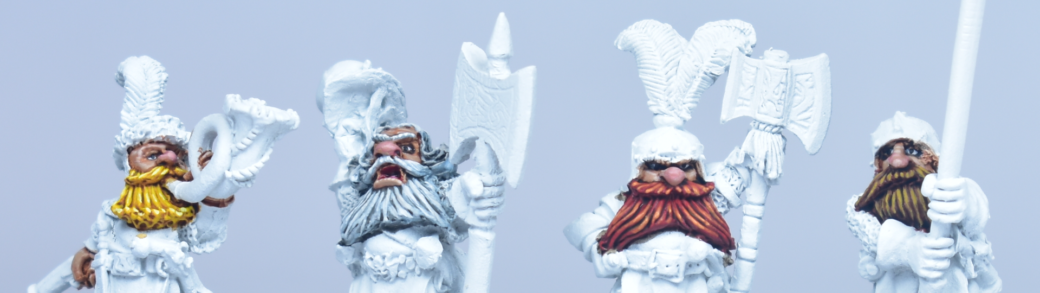
If, like me, you are working on a Dwarf army — it can come in handy to have a few different “Beard Recipes” at hand. In this tutorial I show four different variations: “Golden Blond”, “Blueish Grey”, “Fiery Red”, and “Leathery Brown”.
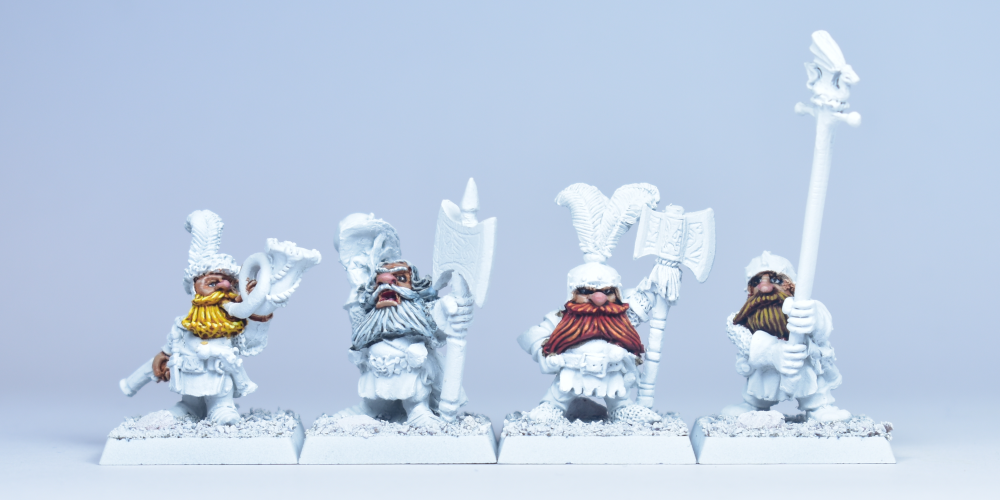
For this tutorial, I use the four models of Ulther’s Dragon Company Command Group, with their faces and skin already painted (see the Painting Dwarf Faces and Skin tutorial).

Quick Summary
If you don’t care about the step-by-step details below, you can find the four different colour schemes here:
Golden Blond
- Averland Sunset
- Seraphim Sepia
- Yriel Yellow
- Flash Gitz Yellow
- Dorn Yellow
Fiery Red
- Mephiston Red
- Agrax Earthshade
- Evil Sunz Scarlet
- Vallejo: Orange Fire
- Fire Dragon Bright
Blueish Grey
- Blue Horror
- Nuln Oil
- Ulthuan Grey
- Pallid Wych Flesh
- Vallejo Dead White
Leathery Brown
- Doombull Brown
- Agrax Earthshade
- Skrag Brown
- Vallejo: Plague Brown
- Zamesi Desert
Base Coats
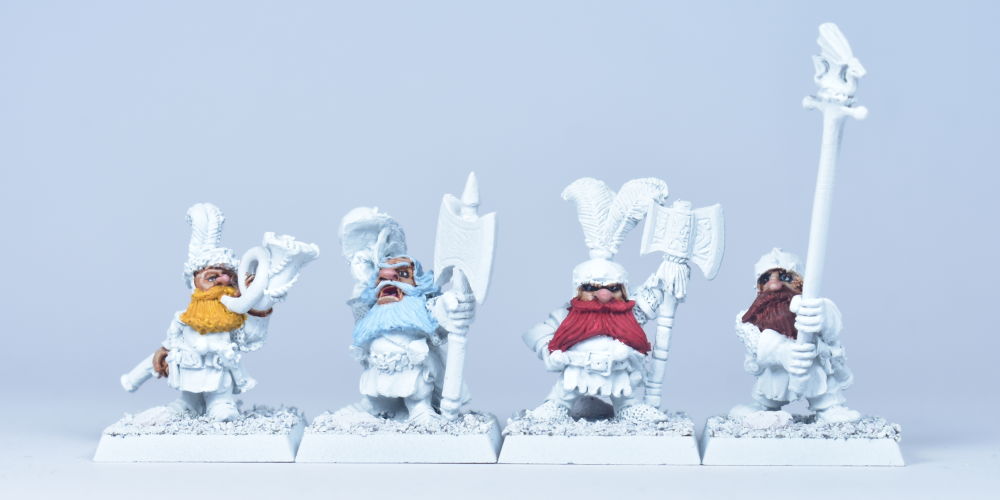
We start with applying our base coats (two thin coats or you’ll upset Duncan). From left to right we use: Citadel: Averland Sunset, Citadel: Blue Horror, Citadel: Mephiston Red, and Citadel: Doombull Brown.
Shading
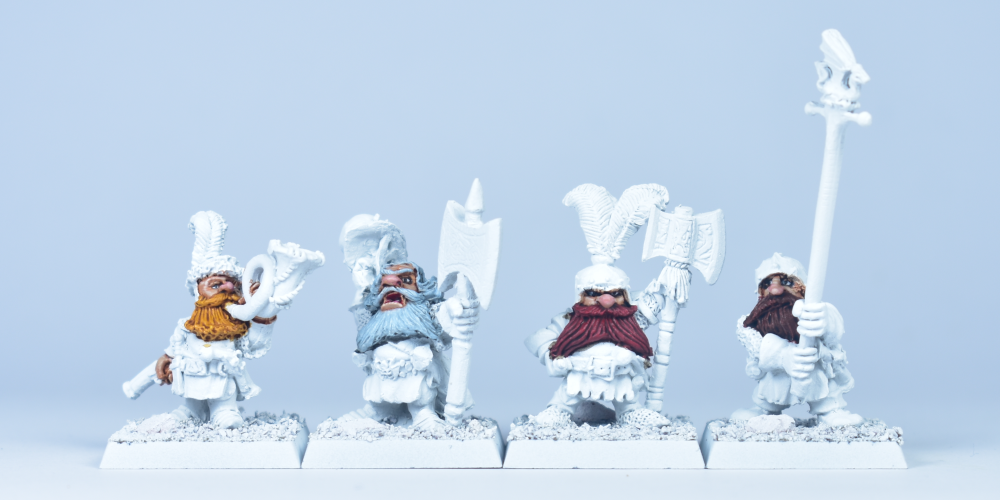
Next up, we use some washes to apply shading. This works really well to bring out the individual strands of hair. From left to right — Citadel: Seraphim Sepia, Citadel: Nuln Oil, Citadel: Agrax Earthshade, and again Citadel: Agrax Earthshade.
First Highlights
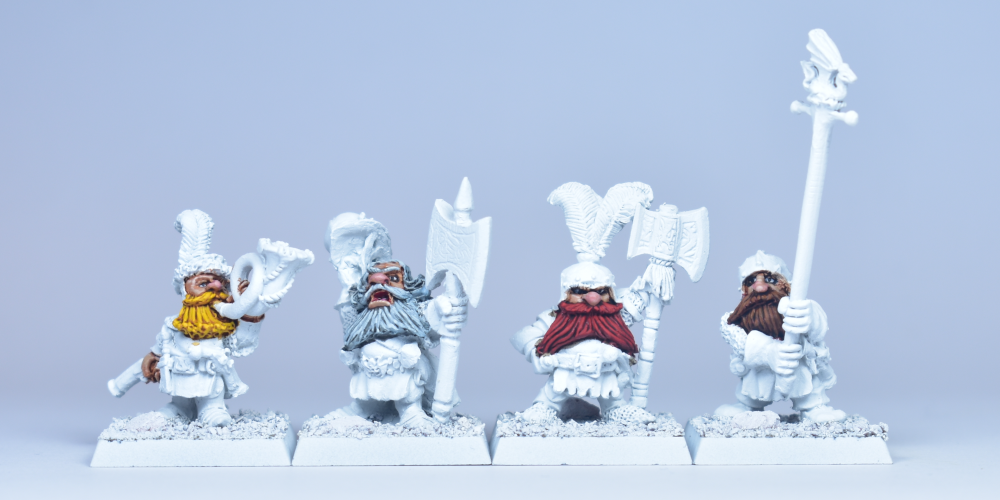
For the first layer of highlights, we focus on accentuating those individual strands of hair. With these models, it was done using a thin brush, painting individual strands. Depending on the sculpt, it may work better to use a “semi-drybrush” technique, pulling the brush perpendicular to the direction of the hairs.
The paints used from left to right were: Citadel: Yriel Yellow, Citadel: Ulthan Grey, Citadel: Evil Sunz Scarlet, and Citadel Skrag Brown.
In case you’re wondering, I mostly use Winsor & Newton, Series 7 brushes for detail work. In the case of painting hair, I use a Size 00.
Second Highlights
In this next stage of highlights, we focus more on the shape of the beard (rather than individual hairs). Still, without getting any paint in the recesses between the hairs, focus on highlighting areas that are more exposed to the sunlight — moustaches and eyebrows, the middle part of the brown and red beards, the tips of flowing strands of hair. The paints used are: Citadel: Flash Gitz Yellow, Citadel: Pallid Wych Flesh, Vallejo: Orange Fire, and Vallejo: Plague Brown.

Third Highlights
The third and final highlight step is to add some final bright touches to the most exposed edges of the beard. The tips of the moustaches and beards, individual strands of hair that stick out, etc. For these, the paints used are: Citadel: Dorn Yellow, Vallejo: Dead White, Citadel: Fire Dragon Bright, and Citadel: Zamesi Desert.
Some reflection…
Even if you paint your Dwarfs using regimental colour schemes, their different individual brightly coloured beards make every Dwarf a little bit unique!
I find painting beards to be quite tricky due to the two different elements of highlighting that should be considered. On the one hand, individual strands of hair should have stark contrast with the ridges between them, and on the other hand, the volumetric shape of the beard should be taken into account when placing highlights.
Finally, the most important advice I can give when painting Dwarf beards: don’t forget the eyebrows!
If you want to see these models fully painted up, check out the tutorial on Painting Prince Ulther’s Dragon Company.
Closing words…
If you have any question, feel free to leave a comment below, or drop me an email at harm@harmsworkshop.com. If you found this very useful and want to show some support, you can do so via my Ko-Fi page.
Proper Dwarfs painted very nice, great to see something other than contrasts and zenithal techniques.
Great work on them.
I too use Winsor & Newton, Series 7 brushes!